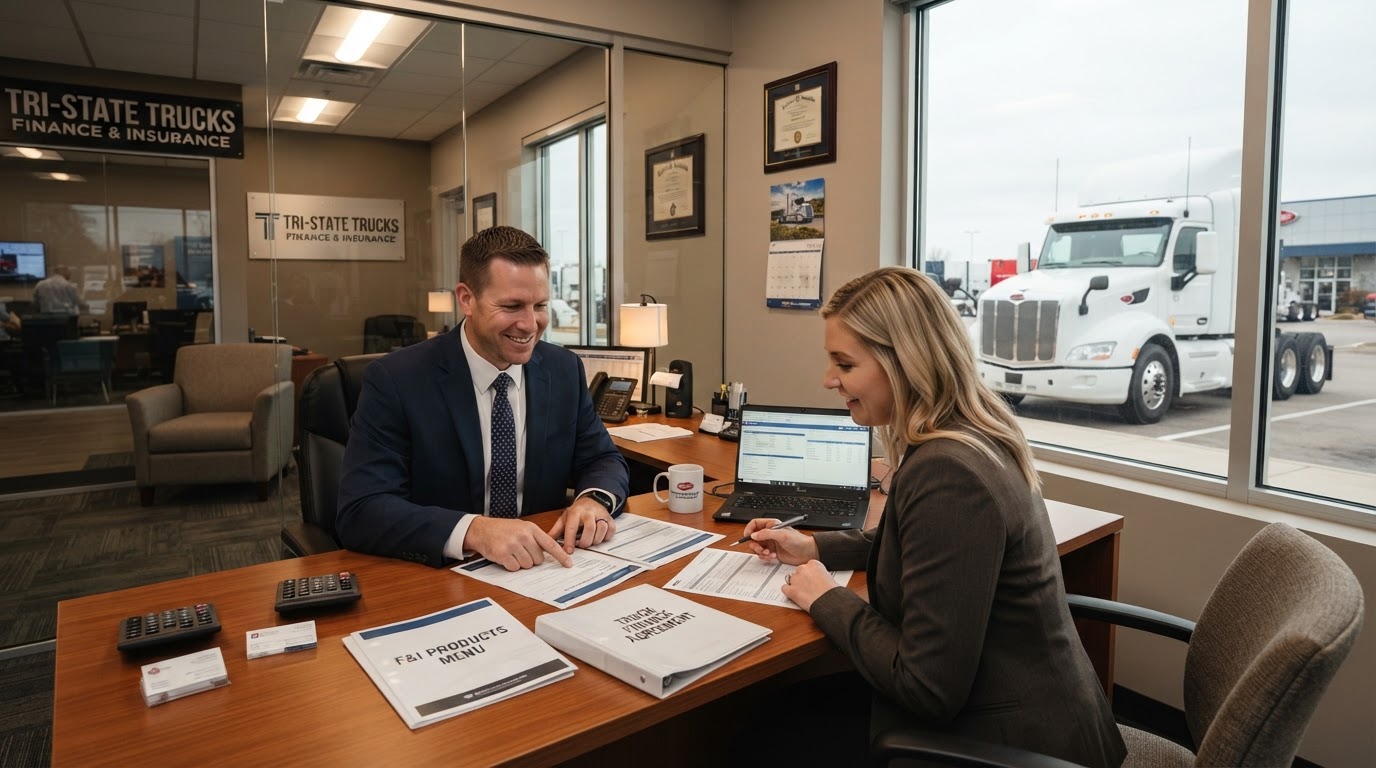
An effective F&I process can increase revenue from transactions the dealership is already completing — without selling another truck. The opportunity isn't simply charging customers more. It's offering the right products, consistently presenting them, and building a repeatable process around F&I.
Here are seven ways commercial truck dealers can potentially increase F&I profit per vehicle.
1. Present F&I Products to Every Eligible Customer
The first opportunity is also the simplest. Don't prejudge the customer.
A salesperson may assume:
"He won't buy a VSC."
"She's putting a lot down, so she won't want GAP."
"That fleet doesn't buy aftermarket products."
Maybe. But let the customer make that decision.
If products are only presented when dealership personnel think a customer will buy them, penetration will almost certainly suffer.
A better approach is to establish a consistent process where every eligible customer receives an explanation of the relevant options.
Consistency creates opportunity.
2. Offer More Than One Product
Some dealerships effectively have a one-product F&I department. They offer a VSC and stop there. For a full overview of available dealer F&I products, see our ancillary products guide.
But commercial customers may face several different risks. Depending on the vehicle and program availability, products might include:
- Vehicle Service Contracts
- Commercial GAP
- Tire & Wheel Protection
- Theft Protection
- Appearance Protection
Each addresses a different concern. A commercial truck Vehicle Service Contract doesn't perform the same function as commercial GAP. GAP doesn't address road-hazard tire damage. Tire & Wheel doesn't address an eligible mechanical breakdown.
Offering multiple appropriate products gives the customer an opportunity to build a protection package based on the risks that matter to their business.
3. Stop Selling Features and Start Explaining Business Risk
Customers don't necessarily care about a long list of contract features. They care about what happens to their business when something goes wrong.
Instead of beginning with:
"This VSC has exclusionary coverage with a $0 deductible option."
Consider beginning with:
"If this truck has a major covered mechanical failure six months from now, what would a $15,000 repair do to your cash flow?"
Now the conversation is relevant.
For GAP:
"If this truck is totaled and your eligible loan payoff exceeds the applicable primary insurance settlement, are you prepared to cover that difference?"
For Tire & Wheel:
"How often are your trucks exposed to road hazards, and what does an unexpected tire or wheel expense cost your operation?"
The product becomes easier to understand when the customer understands the problem it's designed to address.
4. Introduce Protection Before the Final Signature
One of the worst times to introduce five new products is when the customer has already been sitting in the dealership for hours and wants to leave. At that point, every additional conversation can feel like another obstacle.
Instead, introduce the concept earlier. The salesperson doesn't need to give a full F&I presentation. A simple transition may be enough:
"When we finish the financing, we'll also show you a few optional ways to protect the truck and your investment, including service contract and GAP options."
Now the customer knows the conversation is coming. The F&I presentation doesn't feel like a surprise add-on at the end.
5. Train Salespeople to Create the Opportunity
The F&I manager shouldn't be the only person who understands the products. Salespeople should understand enough to recognize opportunities.
If a customer says:
"My last truck cost me $18,000 when the emissions system went down."
That's an opportunity to introduce the VSC conversation.
If a customer says:
"I'm financing almost the entire purchase."
That may create an opportunity to discuss GAP.
If the customer is an owner-operator who can't afford extended downtime, optional downtime or rental benefits available through a VSC may be particularly relevant.
Salespeople don't need to explain the contract. They need to recognize the need and transition the customer appropriately.
6. Track Product Penetration — Not Just Total F&I Gross
If you don't measure it, it's difficult to improve it. Dealers should consider tracking F&I performance by product.
For example:
VSC penetration:
Number of VSCs sold ÷ eligible vehicle transactions
GAP penetration:
Number of GAP contracts sold ÷ eligible financed transactions
The same principle can be applied to other ancillary products. Then look deeper.
- Which salesperson generates the most VSC opportunities?
- Which F&I manager has the highest GAP penetration?
- Which location performs best?
- Which product is rarely presented?
- Where are customers declining?
The goal isn't simply to pressure employees to sell more. The data can reveal where training, product knowledge, pricing, or process improvements may be needed.
7. Understand the Power of Small Improvements
F&I improvements become significant when multiplied across annual dealership volume.
Suppose a dealership delivers 50 commercial vehicles per month. That's approximately:
600 vehicle transactions per year
If an improved F&I process increases average F&I gross by just $500 per vehicle, that's potentially:
600 × $500 = $300,000 in additional annual gross profit
Increase average gross by $750:
600 × $750 = $450,000
At $1,000:
600 × $1,000 = $600,000
These examples are illustrative. Actual performance depends on product penetration, pricing, cancellations, dealership volume, compensation arrangements, customer mix, and numerous other factors.
But they demonstrate an important principle:
You don't necessarily need dramatically more truck sales
to create meaningful additional revenue. Improving the economics of transactions you're already completing can have a major impact.
Build F&I Into the Dealership Culture
The strongest F&I programs aren't dependent on one great F&I manager. They're built into the dealership's process.
- Salespeople understand the products.
- Managers support the process.
- Eligible customers consistently receive the opportunity to consider appropriate products.
- F&I personnel understand the contracts they're presenting.
- The dealership measures results.
That's very different from occasionally asking:
"Do you want an extended warranty?"
Product Knowledge Is Critical
Increasing penetration shouldn't come at the expense of understanding the product. Dealership personnel should know:
- Eligibility requirements
- Coverage or benefit provisions
- Major exclusions
- Available terms
- Deductibles
- Maximum benefits
- Claims procedures
- Cancellation provisions
- Customer pricing
- State availability
This is especially important with products such as commercial GAP and Vehicle Service Contracts. A customer should understand what they're buying.
Don't Evaluate F&I Products on Dealer Cost Alone
Two programs can have similar dealer costs and provide very different customer value. When evaluating a provider, dealerships should look at the complete product.
For a VSC, that might mean examining:
- Coverage level
- Vehicle eligibility
- Mileage eligibility
- Labor reimbursement
- Deductibles
- Claims process
- Roadside assistance
- Optional downtime or rental benefits
For GAP, dealers should understand:
- LTV limitations
- Maximum amount financed
- Maximum benefit
- Eligible finance terms
- Deductible benefits
- How the GAP calculation works
A strong F&I program needs products the dealership can confidently stand behind.
What Could Better F&I Performance Mean for Your Dealership?
Start with three numbers:
How many eligible vehicles do you sell annually?
What is your current F&I gross per vehicle?
What is your current penetration for each ancillary product?
Then calculate what happens if penetration or average F&I gross improves modestly. For many dealerships, the result can be surprisingly large.
Build Your Dealer F&I Program With TrueGuard Insurance
TrueGuard Insurance works with commercial truck dealerships to help develop ancillary F&I programs around the vehicles they're already selling.
Available product categories may include:
- Commercial Vehicle Service Contracts
- Commercial GAP
- Tire & Wheel Protection
- Theft Protection
- Appearance Protection
- Other eligible dealer protection products
We can also work with dealership management, F&I personnel, and sales teams to help them understand the products and develop a more consistent presentation process.
The objective isn't simply to add products to a menu. It's to build an F&I strategy that creates additional dealership revenue while offering customers meaningful protection options.
If you're a commercial truck dealer and want to evaluate your existing F&I program — or build one from the ground up — contact TrueGuard Insurance.
Products are subject to eligibility, provider guidelines, contract terms, conditions, limitations, exclusions, and state availability. Revenue examples are illustrative and are not guarantees of dealership performance.