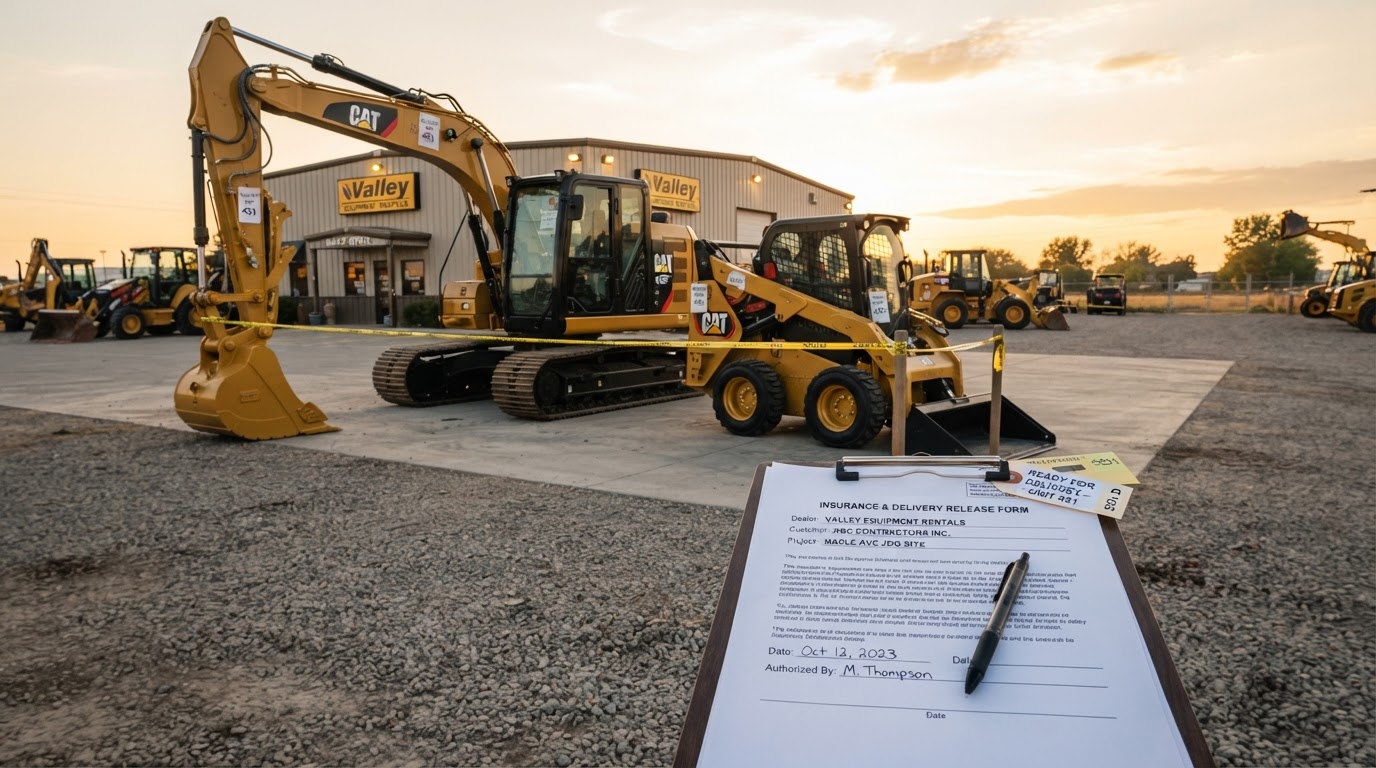
For construction equipment dealers, insurance can become one of the final obstacles between an approved finance transaction and a completed delivery.
The good news is that many insurance-related delays can be avoided.
The key is simple: don't wait until the end of the transaction to address insurance.
Why Insurance Can Hold Up an Equipment Finance Deal
When a lender finances construction equipment, it has a financial interest in the asset being financed. Before funding the transaction, the lender will typically require evidence that the equipment has appropriate insurance coverage.
Depending on the lender and transaction, that may involve requirements regarding:
- Physical damage coverage
- Deductibles
- Lienholder or loss-payee information
- Policy effective date
- Equipment identification
- Other lender-specific requirements
If the customer's existing insurance doesn't satisfy those requirements — or if the Certificate of Insurance for equipment financing is incorrect — funding can be delayed. And when funding is delayed, delivery may be delayed too.
The Problem With Waiting Until Delivery Day
Insurance is sometimes treated as one of the final items on the closing checklist. That creates unnecessary risk.
Imagine a customer purchasing a $200,000 excavator.
The customer has been approved for financing. Documents are prepared. Transportation has been scheduled. The customer needs the machine on a jobsite.
Then the lender requests proof of insurance.
The customer calls an insurance agent. The agent needs additional information. The dealer sends the serial number. The agent issues a certificate. The lender reviews it and discovers the lender information isn't correct.
Now everyone is waiting.
The problem wasn't necessarily obtaining insurance.
The problem was when the insurance process started.
Start the Insurance Conversation Earlier
Dealers don't need to become insurance agents. They simply need to identify whether insurance could become a funding requirement early enough to do something about it.
Once financing is being discussed, ask the customer:
"Do you already have insurance lined up for this equipment?"
If yes, great. The next question should be:
"Can your agent provide the lender with the required proof of coverage before delivery?"
If the customer isn't sure, address it then — not when the truck is waiting to haul the machine away.
Know What Information the Insurance Agent Will Need
A dealer can make the insurance process much faster by having the basic transaction information ready.
Customer Information
Typically:
- Customer or business name
- Contact information
- Garaging address
- Intended use of the equipment
Equipment Information
Typically:
- Year
- Make
- Model
- Serial number
- Insured value or purchase price
Finance Information
Typically:
- Lender
- Lender insurance address
- Finance term
- Required lienholder or loss-payee information
Having accurate information available reduces emails, phone calls, and corrections.
Get the Lender Requirements Right the First Time
One of the easiest ways to delay funding is to provide incorrect lender information. Don't assume.
If the lender provides insurance instructions, send those instructions to the insurance agent. This can help avoid common problems involving:
A COI that has to be corrected two or three times isn't fast — even if the original certificate was produced quickly. The goal should be to get the documentation right the first time.
Create an Insurance Checkpoint in Your Sales Process
Dealerships can make this remarkably simple. Add an insurance checkpoint to the normal finance workflow.
The dealership isn't selling or advising on insurance unless appropriately licensed and authorized to do so. It's simply identifying whether a financing requirement has been completed. That small operational change can prevent a last-minute scramble.
Give the Customer an Insurance Option
Another issue arises when a customer doesn't have an agent who can quickly handle the equipment. The customer may call a personal insurance agent who doesn't regularly insure construction equipment. Or the customer may be a new business purchasing its first machine.
Now the dealer has a finance approval but no clear path to obtaining the required coverage. Having an insurance resource available gives the dealer somewhere to direct the customer.
The customer remains free to use the insurance provider of their choice, but the dealership doesn't have to simply say:
"Call us when you figure out the insurance."
A Faster Option for Eligible Construction Equipment Customers
TrueGuard Insurance works with construction equipment dealers to help eligible customers obtain physical damage insurance for financed equipment through our construction equipment insurance program. For qualifying transactions, the program is designed to make the process straightforward.
Pre-Approved
Up to $500,000 in equipment value without a traditional insurance application, subject to program eligibility.
Fast Quotes
Quotes produced quickly once required equipment and customer information is received.
Same-Day Binding
Coverage can be bound the same day for eligible transactions, with documentation issued for lender requirements.
Works With Any Lender
A construction equipment insurance solution shouldn't force the dealer to change the way it finances customers. TrueGuard's construction equipment physical damage program can work with eligible transactions financed through different lenders.
That allows dealers to maintain their existing lender relationships while giving customers another option for satisfying physical damage insurance requirements.
Locking in the Premium Can Help Customers Too
For eligible financed equipment, the monthly insurance premium may be locked in for the finance term for up to 72 months, subject to program terms. That can provide the customer with predictable equipment insurance costs rather than having to obtain and renew a separate annual policy each year.
For some customers, simplicity and predictability can be valuable.
Two Easy Ways to Request a Quote
Dealers and their sales teams can make the process simple. A quote can be requested through TrueGuard's construction equipment insurance website, or the required information can be sent directly to TrueGuard.
Typically, we need:
- Equipment year, make and model
- Serial number
- Insured value
- Garaging location
- Intended use
- Customer information
- Finance term, when applicable
Once the information is received, eligibility can be reviewed and a quote produced.
Don't Let Insurance Be the Last Thing Holding Up the Deal
Dealers spend significant time generating leads, selling equipment, negotiating transactions, obtaining financing approvals, and preparing machines for delivery. After all of that work, an insurance certificate shouldn't be the reason the transaction stalls.
The solution doesn't have to be complicated.
For construction equipment dealers, TrueGuard Insurance can help make insurance one less thing standing between approved and delivered.
Request a Construction Equipment Insurance Quote
TrueGuard Insurance can help determine eligibility, provide a quote, bind eligible coverage, and issue the documentation needed for the lender.
Coverage is subject to eligibility, underwriting guidelines, policy terms, conditions, exclusions, limits, and availability. Program features may vary by transaction and jurisdiction.
Related Coverages
Matt Nelson
Founder, TrueGuard Insurance. Licensed professional specializing in commercial trucking, construction equipment, and dealer programs across multiple states.
Related Articles
Why Was My Certificate of Insurance Rejected by the Lender?
9 common reasons lenders reject COIs
What Do You Need to Fund a Class 8 Truck or Construction Equipment Finance Deal?
Insurance requirements for equipment financing
Dealer F&I Products: How Ancillary Products Can Add Value and Increase Dealership Revenue
VSCs, GAP, Tire & Wheel, and more