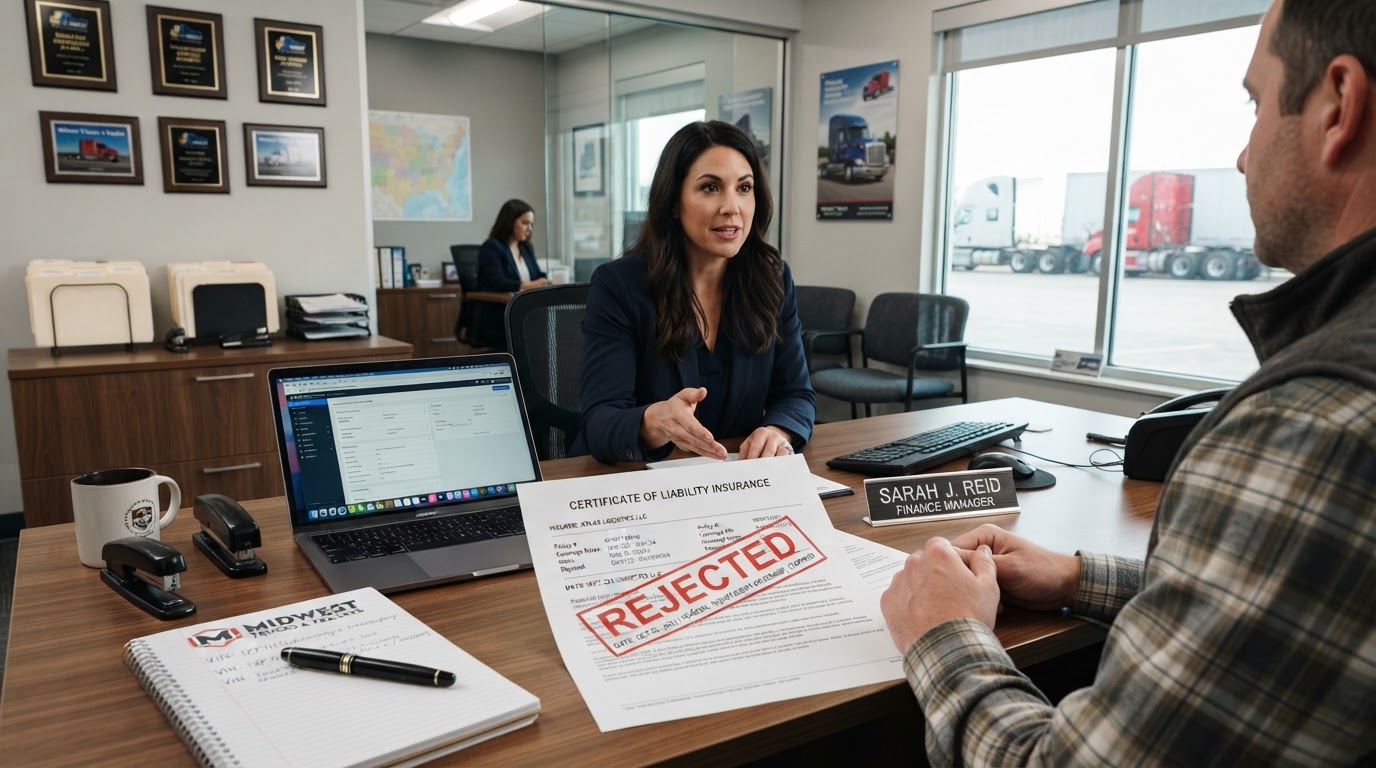
For equipment dealers and commercial customers, few things are more frustrating than having a transaction delayed because of an issue with proof of insurance. A Certificate of Insurance, commonly called a COI, may look straightforward, but lenders often have specific insurance requirements that must be satisfied before they will fund a transaction.
Here's why a COI may be rejected — and how dealers and customers can reduce the chances of it happening. For the broader picture on equipment financing insurance requirements, see our funding guide.
Why Does the Lender Need Proof of Insurance?
When a lender finances a Class 8 truck, excavator, skid steer, wheel loader, or other expensive piece of equipment, that asset typically serves as collateral for the financing.
If the equipment is severely damaged, destroyed, or stolen, the lender has a financial interest in the property. That's why lenders commonly require evidence of appropriate insurance before releasing funds.
The COI or other acceptable evidence of coverage helps demonstrate that required coverage is in place. But simply sending the lender a certificate doesn't necessarily satisfy the requirement. The information needs to be correct.
9 Common Reasons a COI Gets Rejected
1. The Lender's Name Is Incorrect
One of the simplest problems can also create a funding delay. Financial institutions frequently have specific legal names that need to appear on insurance documentation. A dealer or customer may use a shortened name while the lender requires a specific legal entity. Even if everyone knows which lender is involved, the lender may request a corrected certificate before proceeding.
Best practice:
Obtain the lender's exact insurance instructions rather than assuming the proper legal name.
2. The Lender Address Is Wrong
Large financial institutions may have multiple addresses. The address used for payments may not be the same address used for insurance documentation. Some lenders maintain specific addresses for lienholder, loss-payee, or insurance purposes. Using an address from an old transaction or finding a corporate address online can result in a rejected certificate.
Best practice:
Use the lender's current insurance instructions for the specific transaction.
3. The Lender Isn't Shown in the Required Capacity
Depending on the transaction and insurance policy, the lender may require an appropriate loss-payee or similar interest to be reflected. Simply listing the lender somewhere on the certificate may not satisfy the lender's requirements. This is an important distinction because the lender has a financial interest in the financed property. The applicable policy and endorsements — not the certificate alone — determine the parties' actual rights and coverage.
4. The Equipment Information Is Incorrect
A one-character error can create a problem. Common mistakes include:
When a lender is financing a specific asset, the insurance documentation should correspond to that asset. Dealers can help by providing accurate equipment information directly from the sales or financing documents.
5. The Policy Effective Date Doesn't Work
Timing matters. If the customer is taking delivery on August 20 but the required coverage isn't effective until August 21, the lender may not fund the transaction. The lender generally wants confirmation that the required coverage is in effect when its financial interest begins. Dealers should coordinate delivery, financing, and insurance effective dates rather than treating them as separate processes.
6. Required Physical Damage Coverage Isn't Evident
For financed vehicles or equipment, lenders may require appropriate physical damage coverage protecting the financed collateral. If the evidence provided doesn't demonstrate the required coverage, the lender may request additional documentation or correction. The exact insurance requirements depend on the lender, asset, transaction, and applicable policy.
7. The Deductible Doesn't Meet Lender Requirements
Some lenders establish maximum acceptable deductibles for financed collateral. A customer may technically have physical damage coverage but carry a deductible higher than the lender permits. That can create another last-minute problem. The issue isn't necessarily that the customer lacks insurance. It's that the insurance arrangement may not satisfy the lender's financing requirements.
8. The Customer Added the Equipment but Didn't Update the Lender Information
Customers with existing commercial insurance may contact their agent and add a newly purchased truck or piece of equipment to their policy. That's an important first step. But the agent also needs the appropriate lender information and any applicable requirements. Otherwise, the customer may be insured while the documentation still doesn't satisfy the finance company.
9. The COI Is Not the Insurance Policy
This is an important point for dealers and customers to understand. A Certificate of Insurance generally provides evidence or information regarding insurance coverage. It does not itself create or modify coverage. Actual coverage is governed by the insurance policy and applicable endorsements. That's why an insurance agent may need additional information or may need to make changes to the policy before appropriate evidence can be provided.
How Dealers Can Prevent COI Problems
The easiest way to solve a COI problem is to address insurance before the customer is waiting for delivery.
As soon as financing is being finalized, obtain:
Customer Information
- Correct legal/business name
- Address
- Contact information
Equipment Information
- Year, make, model
- VIN or serial number
- Purchase price
- Intended use
Lender Information
- Exact lender legal name
- Insurance/lienholder address
- Any required loss-payee wording
- Required coverage
- Maximum deductible, if applicable
Then send the complete information to the insurance agent.
Dealers Should Ask for the Lender's Insurance Instructions
One of the most effective habits an equipment dealership can develop is obtaining the lender's insurance requirements before requesting the COI.
Instead of telling the insurance agent:
"We need a COI for ABC Bank."
Provide the lender's actual instructions whenever available. That reduces assumptions and gives the agent a clearer picture of what documentation is required.
Why This Matters for Construction Equipment Dealers
Insurance delays can be especially frustrating in equipment transactions. The customer may have:
If insurance isn't addressed until the end, everyone may be waiting on one document before the equipment can leave. That creates unnecessary friction for the customer, dealership, lender, and insurance agent.
Build Insurance Into the Sales Process
Rather than treating insurance as a final funding condition, dealerships can make it part of the transaction workflow. A simple process might look like:
The exact order will vary by lender and transaction, but the principle is the same:
Don't wait until delivery day to discover an insurance problem.
How TrueGuard Insurance Helps Equipment Dealers
TrueGuard Insurance works with construction equipment dealers and their customers to help streamline physical damage insurance for eligible equipment transactions.
For eligible risks, our construction equipment insurance program is designed to provide a straightforward path from quote to coverage and lender documentation. That can include:
The goal is simple: Help dealers move from approved financing to funded and delivered equipment without insurance becoming the bottleneck.
Need insurance for an equipment transaction?
Contact TrueGuard Insurance to determine whether the equipment and customer qualify for our program.
Insurance coverage is subject to underwriting eligibility, policy terms, conditions, exclusions, limits, and state availability. A Certificate of Insurance provides evidence of coverage and does not amend, extend, or alter the coverage provided by the applicable insurance policy.