Inland Marine Insurance for North Carolina Contractors: The Missing Coverage You Cannot Afford to Skip
If you are a contractor in Winston-Salem, Greensboro, or anywhere across the Piedmont Triad, your tools and equipment are your livelihood. But if you think your general liability or commercial property policy covers them, you could be in for a devastating surprise. Here is everything you need to know about inland marine insurance.
What Is Inland Marine Insurance?
Despite the name, inland marine insurance has nothing to do with boats or water. The name dates back to the 19th century when it was created to cover goods being transported over inland waterways. Today, it has evolved into a specialized line of commercial insurance that covers mobile property—tools, equipment, materials, and goods that move from location to location or are in transit.
For North Carolina contractors, inland marine insurance is the coverage that fills the gap left by your general liability and commercial property policies. It protects the physical assets that your business depends on, wherever they happen to be.
Why Your General Liability and Property Policies Are Not Enough
This is the most common—and most dangerous—misconception we see among contractors in the Winston-Salem area. Here is how the three main commercial policies divide responsibility:
The Three Pillars of Contractor Coverage
The bottom line: if your $15,000 skid steer is stolen from a job site in Clemmons, your commercial property policy will not cover it because it is not at your insured location. Your general liability will not cover it because it is your property, not a third party's. Only an inland marine policy will respond.
What Does Inland Marine Insurance Cover for Contractors?
Inland marine coverage is highly customizable, but for North Carolina contractors, the most critical protections include:
1. Contractor's Equipment and Tools
This is the core of most contractor inland marine policies. It covers power tools, hand tools, generators, compressors, welding equipment, and other gear—whether it is in your truck, at a job site, or in storage. Coverage typically includes theft, vandalism, fire, windstorm, and accidental damage.
2. Mobile and Heavy Equipment
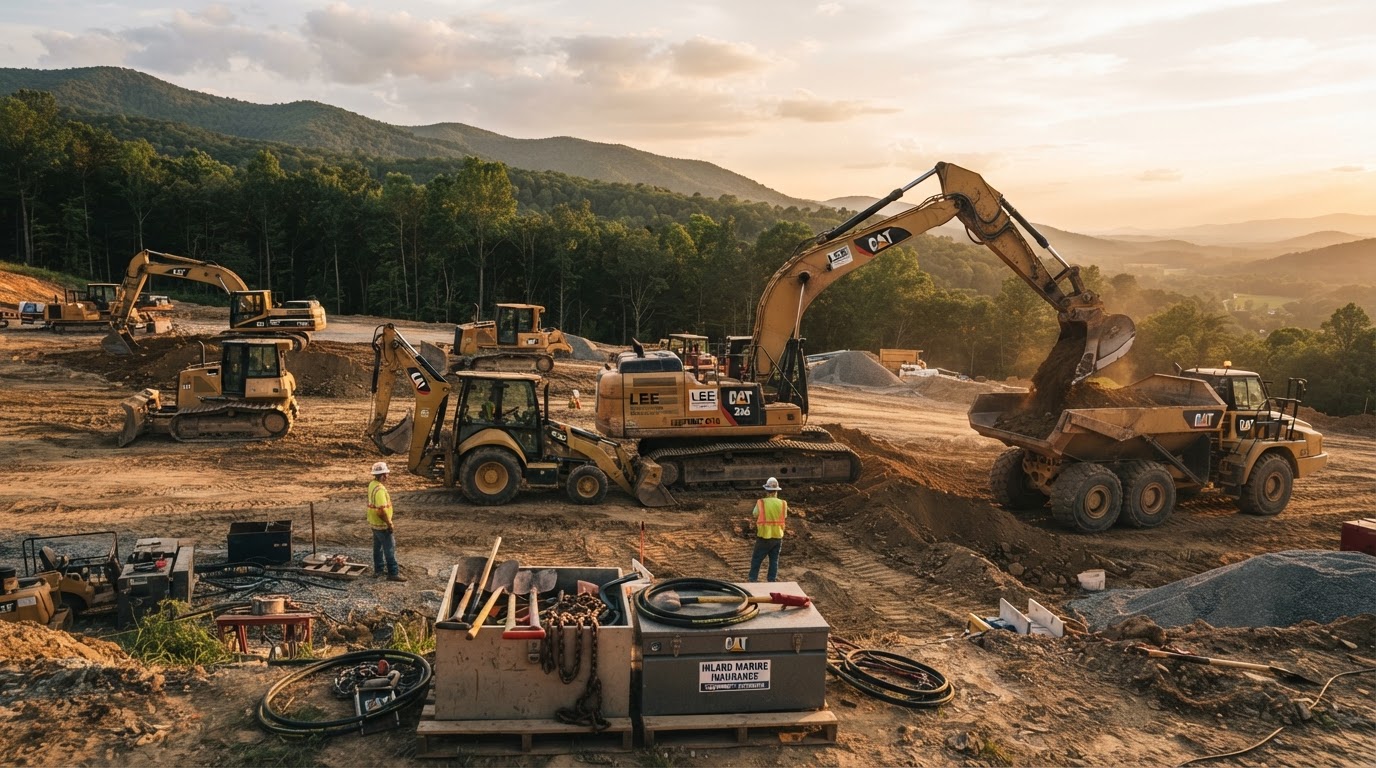
Excavators, backhoes, skid steers, bulldozers, forklifts, and other heavy machinery are often the most valuable assets a contractor owns. Inland marine can cover these items for physical damage, theft, and even overturn or collision while being transported.
3. Materials in Transit
If you are hauling lumber, steel, concrete forms, or other building materials from a supplier in Winston-Salem to a job site in Kernersville, inland marine covers those materials while they are on the road. If a load shifts and is damaged, or if materials are stolen from your trailer at a gas station, the policy responds.
4. Rented and Borrowed Equipment
Many contractors rent equipment for specific projects. If you rent a scissor lift from a dealer in Greensboro and it is damaged or stolen while in your possession, you are responsible for it. Inland marine can include coverage for rented and borrowed equipment, saving you from having to buy the rental company's expensive damage waiver.
5. Installation Coverage (Installation Floater)
An installation floater covers materials and equipment that have been delivered to a job site but not yet installed or incorporated into the structure. For example, if you deliver $20,000 worth of custom cabinetry to a home in Bermuda Run and it is damaged by a storm before installation, the installation floater covers the loss.
6. Goods in Transit (for Supply and Delivery Contractors)
If your business includes transporting goods for others—such as a building supply delivery service—inland marine can cover the cargo you are hauling, protecting you from liability for damaged or lost freight.
Real-World Claim Scenarios for NC Contractors
Tool Theft from a Job Site
A plumbing contractor in Winston-Salem leaves $8,000 worth of power tools and pipe-fitting equipment in a locked trailer at a job site overnight. Thieves cut the lock and steal the trailer and all contents. The commercial property policy denies the claim because the loss occurred off-premises. The inland marine policy covers the full replacement cost.
Equipment Damage in Transit
An excavating contractor is transporting a mini-excavator on a trailer from Lewisville to a job site in Mocksville. The trailer hits a pothole on I-40, the excavator shifts, and the boom is damaged. The repair costs $12,000. The inland marine policy covers the equipment damage; the commercial auto policy covers the trailer and truck.
Rented Equipment Loss
A general contractor rents a $45,000 telehandler for a project in Advance. During the job, a severe thunderstorm topples a tree onto the machine, causing extensive damage. Without inland marine coverage for rented equipment, the contractor would be personally responsible for the repair bill—or the full replacement cost if the machine is totaled.
How Much Does Inland Marine Insurance Cost in North Carolina?
Inland marine insurance is surprisingly affordable relative to the value it protects. For a typical small contractor in the Piedmont Triad with $25,000–$50,000 in tools and equipment, an inland marine policy might cost between $300 and $800 per year. For contractors with heavy equipment valued at $100,000 or more, premiums typically range from $1,000 to $3,000 annually.
Factors that affect your premium include:
- Total value of insured equipment: Higher limits mean higher premiums, but the cost per dollar of coverage decreases as limits increase.
- Type of equipment: High-theft items like generators and compact track loaders carry higher rates than stationary or specialized tools.
- Deductible: Choosing a $1,000 or $2,500 deductible instead of $500 can reduce your premium by 15–25%.
- Loss history: A clean claims record keeps rates low; multiple prior losses will push premiums up.
- Geographic area: Equipment regularly used in higher-crime urban areas may carry slightly higher rates than equipment used in rural Davie or Yadkin County.
Scheduled vs. Blanket Coverage: Which Is Right for You?
When structuring your inland marine policy, you will choose between two approaches:
- Scheduled coverage: Each individual piece of equipment is listed on the policy with a specific value. This is ideal for high-value items like excavators, cranes, and specialized machinery. It provides the most precise coverage but requires updating the schedule whenever you buy or sell equipment.
- Blanket coverage: A single limit covers all tools and equipment up to a maximum amount, without listing each item individually. This is ideal for smaller tools, hand tools, and equipment that changes frequently. It is more flexible and easier to manage.
Most contractors benefit from a hybrid approach: blanket coverage for tools and smaller equipment, and scheduled coverage for high-value machinery. TrueGuard can help you determine the right structure based on your inventory.
How to Lower Your Inland Marine Premium
- Maintain an equipment inventory: Keep a detailed log with serial numbers, photos, and purchase receipts. This speeds up claims and can help you avoid over-insuring.
- Secure your equipment: Use locked trailers, job-site storage containers, and GPS tracking on high-value items. Some carriers offer discounts for anti-theft measures.
- Choose the right deductible: If you can absorb a $1,000 or $2,500 out-of-pocket loss, raising your deductible can significantly reduce your annual premium.
- Bundle with your other commercial policies: Combining inland marine with your general liability, commercial auto, and workers' comp can unlock multi-policy discounts.
- Review annually: Equipment values change. Over-insuring wastes money; under-insuring risks a gap. An annual review with TrueGuard ensures your limits stay accurate.
Why Winston-Salem Contractors Choose TrueGuard
At TrueGuard Insurance, we work with contractors across the Piedmont Triad—from solo tradespeople in Clemmons to large excavating firms in Lexington. We understand the specific risks of working in North Carolina, from summer thunderstorms that can flood a job site to the theft risks that come with leaving equipment on a site in an urban area.
As an independent agency, we shop your inland marine coverage across 25+ top-rated carriers to find the best combination of coverage and price. We also help you structure your policy correctly—ensuring there are no gaps between your general liability, commercial auto, and inland marine coverage.
Protect Your Tools and Equipment
Do not wait until a theft or accident exposes a gap in your coverage. Get a free inland marine insurance quote from TrueGuard today and make sure your equipment is protected wherever the job takes you.